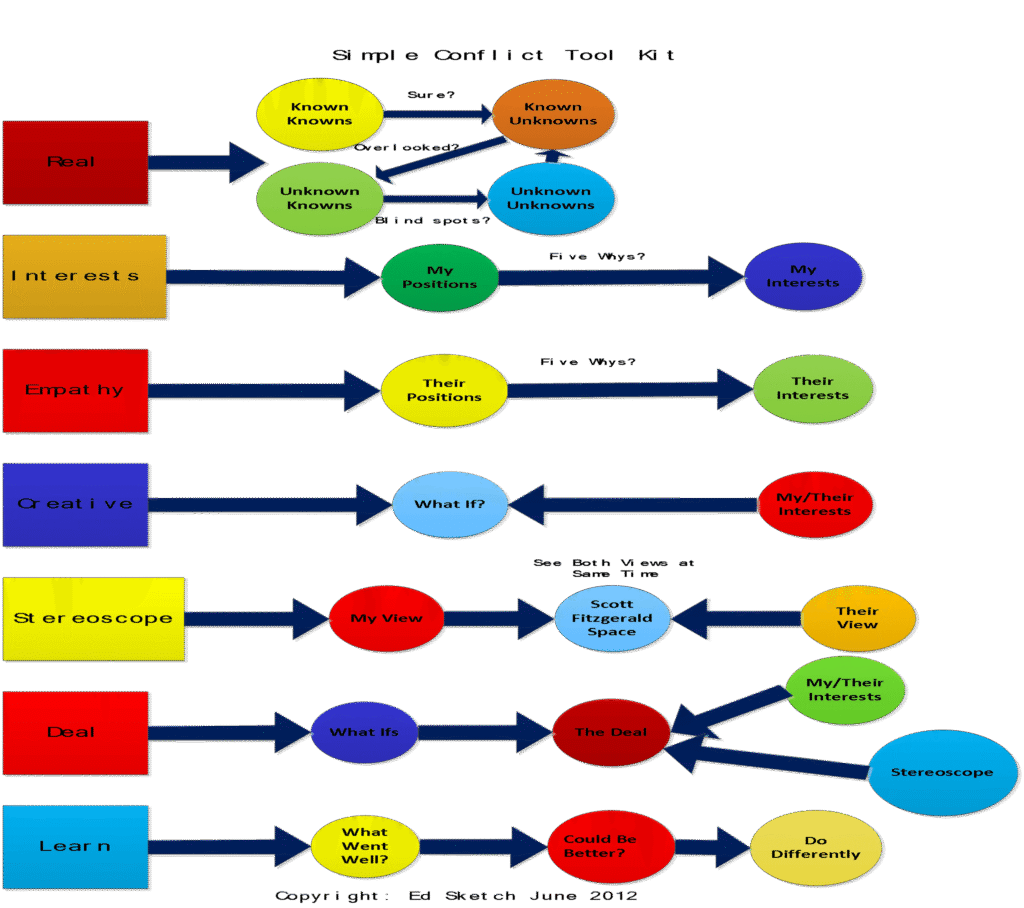

We don’t stand much chance of handling a conflict successfully without some clarity about its nature. Who is involved, what the conflict is about and what data do we have that throws light on what is going on. Specifically, we should ask ourselves:
- What is the potential conflict situation?
- What data do we have on the situation? What do you know? Our starting point.
- What do we know we don’t know and how can we find out? Our research agenda
- What don’t we know we know? What are we overlooking in the data we have? Our files about the conflict and its history so far.
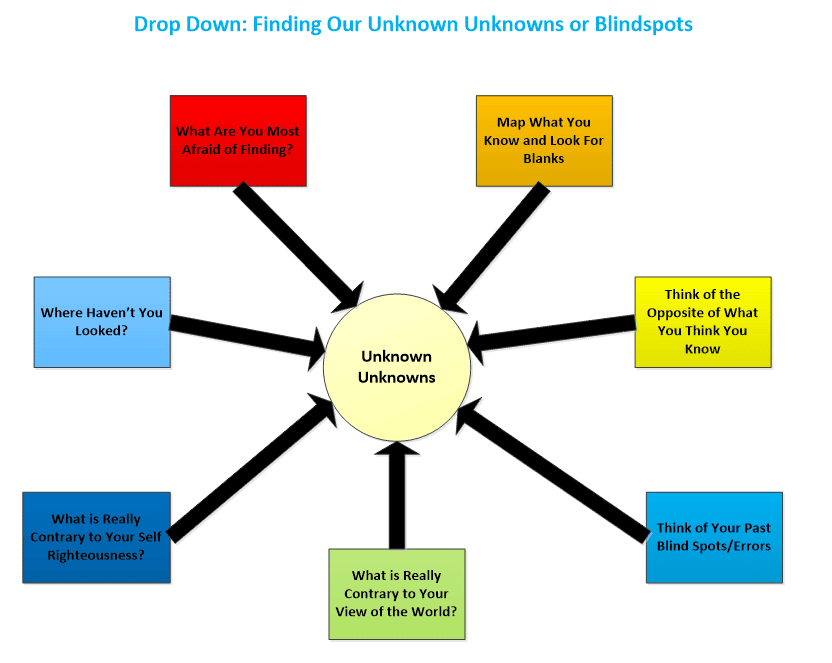
- What don’t we know we don’t know? What are our blind spots?
- Repeat this process for the other side: What do they know, etc.?
- What biases do we have? Which of our lenses might be distorting our view of reality?
- What distortions does our self-interest create? Are we mixing up what you want with its current reality?
- What are the biases and lenses of the other side? What impact do they have?
- Do any of these biases apply to us?
- What distortions does the other side’s self-interest create for us? Are they mixing up what they want with current reality?
- Are they trying to manipulate how we see reality for their own ends, or are they genuinely misguided about the situation (watch out for self-righteousness in this)?
- Using all the data you have collected and have added/modified using the above questions, what does the conflict situation now look like?
- Before entering any negotiation, establish our Best Estimate of the Best Alternative to a Negotiated Agreement (BEBATNA), or what can we can achieve without negotiating; our walk-away option. You should not settle for anything worse than this.
- We might also consider and discuss what ways should be used to divide up any gains achieved by successful creative conflict handling.
| #1: What do I know I know? | #2: What do I know I don’t know? |
| #3: What don’t I know that I know? | #4: What don’t I know that I don’t know? |
What is our BEBATNA?: Our Best Estimate of the Best Alternative to a Negotiated Agreement:
We have seen the profound difference between the positions we take in conflict that are often based on self-righteous wishful thinking and the importance of drilling down beneath them to understand our interests in the conflict, our real needs in relation to the conflict outcome. We should therefore ask ourselves:
- In the conflict situation we face, what are our long-term goals?
- How might the future play out in a way that might impact your goals?
- What real underlying interests support our goals?
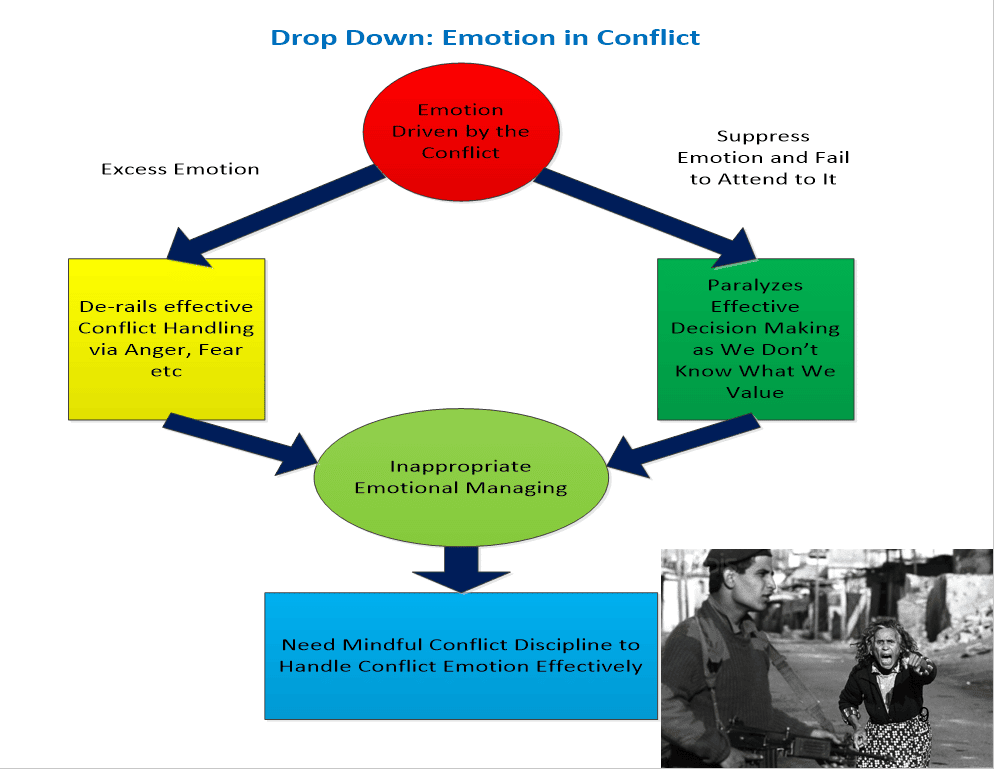
- Stressful conflict triggers automatic fight/flight reflexes and mental short-cuts. What automatic, instinctive reactions might be influencing our views of our interests: fight/flight/submit/dominate/freeze?
- We need to surface the emotions and “Blink” intuitions that are driving us and reflect on their impact without becoming paralyzed.
- For really complex problems, we need our emotions to focus us on what is important and make sense of the complexity.
- What feelings do we experience when we consider our interests?
- Does this tell us anything about their relative importance?
- What beliefs about the world might be influencing our view of your interests?
- We need mindfully to attend to these processes, evaluate their output and decide on our real interests, not just feeling we want “x,” but understanding why we want “x.”
- If we have existing views about our conflict position, subject them to Root Cause Analysis. This involves our interrogating the positions, analyzing them and getting into our “real” interests.
- Look at each demand or position and ask “Why?” Why do we want this? Then repeat this questioning up to four more times for each reason. The purpose is to derive our underlying real interests.
- With this focus, we can look for opportunities to grow what is being divided up and use the surfaced real interests of both sides to explore possibilities for mutual gain.
- We need to recognize that interests can be common, different, or conflicting.
- Common and different interests allow trade-offs over conflicting interests and we can “grow the size of the pie” being divided.
- Is there anything we don’t know about our interests?
- Once we have completed this process, we need to record it in writing, for reference, to allow us to feel comfortable exploring the other side’s interests in the next stage.
| E1 | E2 | E3 | E4 | E5 | |
|---|---|---|---|---|---|
| Elements of your Positions: What we are demanding: | |||||
| Why? | |||||
| Why? | |||||
| Why? | |||||
| Why? | |||||
| Why? |
Empathy is, perhaps, the most important quality in conflict. It is not the same as sympathy, or feeling positively about the other’s feelings. Effective empathy does not involve losing sight of your interests or feelings. It is founded on automatic (mirror neuron mediated) simulations, which allow us to “mind read” the other side, in some respects, and gain valuable insight into their interests and their emotions. So our questions at this stage should reflect some of the same questions of the previous stage but in this case applied to the other side in the conflict:
- Empathy needs to be surfaced and interrogated, rather than allowed to make us uncritically sympathetic.
- If we lose sight of your own interests, we may be exploited by the other side.
- If we lose sight of the other side’s interests, we may be blocked from finding a good solution.
- Empathy should be used in tandem with systemically understanding what is driving what is going on, and in the context of our own interests. To do this effectively, repeat the process we used to understand your own interests, but this time for the other side. (See Stage 2.)
- If some trust has been built up we could do this in collaboration with the other side
- But if not, we can do it privately in preparation for the negotiation
- There are likely to be far more things we do not know about the other side’s interests or how they feel about them/value them. But they may not know some of this stuff either.
- Negotiation can be seen as partly about exploring the other side’s interests to fill in these blanks
- In the conflict situation, what are the long term goals of the other side?
- How might the future play out in a way that might impact their goals?
- Stressful conflict triggers automatic fight/flight reflexes and mental short-cuts. What automatic, instinctive reactions might be influencing their views of our interests (fight/flight/submit/dominate/freeze)?
- We need to surface the emotions that are driving them and reflect on their impact
- For really complex problems, they may need their emotions to keep them focused on what is important and make sense of the complexity and we should be aware of this.
- What feelings does the other side appear to experience when we consider their interests? Does this tell them/us anything about their relative importance?
- What beliefs about the world might be influencing their view of their interests? They may need mindfully to attend to these processes, evaluate their output, and decide on their real interests, not just feeling they want “x,” but understanding why they want “x”?
- If the other side has existing views about their conflict position, that is, what they are going to demand, subject them to Root Cause Analysis. This involves our helping them interrogate their positions, analyze them and getting into their real interests (or our doing it unilaterally as part of negotiation preparation).
- We should look at each of their demands or positions and ask “Why?” Repeat this questioning up to four more times for each reason. The purpose is to derive their underlying real interests
- With this focus, we can look for opportunities to grow what is being divided up and we can use the surfaced real interests of both sides to explore possibilities for mutual gain.
- We need to recognize that interests can be common, different, or conflicting. Common and different interests allow tradeoffs over conflicting interests and we can ‘grow the size of the pie’ being divided
- Is there anything we don’t know about the other side’s interests?
- Once we have completed this process, we need to return to the listing of our own interests we prepared in Stage 2 to allow us to feel comfortable exploring other side’s interests. We might have some new insights on our own interests too.
| E1 | E2 | E3 | E4 | E5 | |
|---|---|---|---|---|---|
| Elements of Their Positions/ What they Demand | |||||
| Why? | |||||
| Why? | |||||
| Why? | |||||
| Why? | |||||
| Under lying interest |
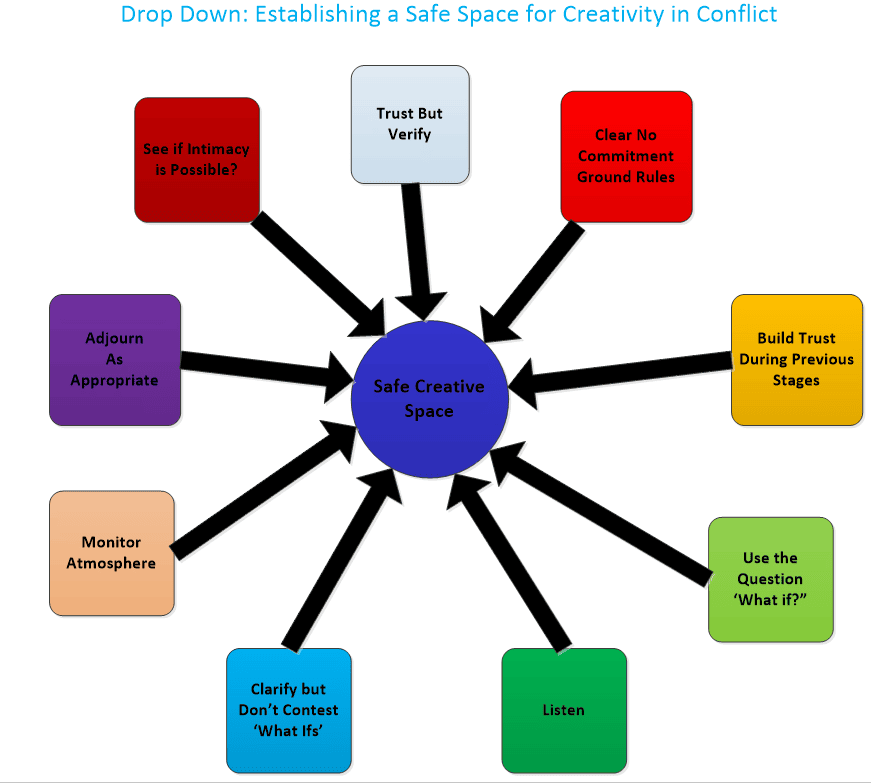
Once we have successfully established own real interests and empathetically understood those of the other side, we can start to expand the range of possible solutions to the conflict and “get creative. We are looking to find new elements that might fit into a negotiated and agreed solution to the conflict. This stage should be carefully set up on the understanding that what is raised is not necessarily agreed to but is exploring all the possibilities before deciding if they are acceptable to either side. So we proceed to:
- If trust has reached a level where it is possible to “get creative” jointly and collaboratively, we should brainstorm jointly with the other side. Otherwise, have a private brainstorming session as part of continuing negotiation preparation.
- Compare our interests with their interests and map which are common, which are in conflict, which are merely different (non-rival).
- Common and different interests allow trade-offs over conflicting interests and can “grow the size of the pie” being divided
- Using this for guidance, and starting from each side’s interests, begin to ask “What if?” or “Why not?” of a wide variety of possible options to resolve the situation.
- Repeatedly ask the question “What if?” or “Why not?” around all aspects of the conflict.
- This I stress should be on the understanding that there is no immediate commitment on either side to the “What if?” or “Why not?” We are simply opening the suggestion for discussion.
- There will be opportunities at the next stage to compare these options with our and their real interests.
- Use the rules of brainstorming and record output.
- Keep asking if we can do better than a suggested “What if?”
- Notice any beliefs or lenses (from Stage 1-3) that may affect our/their judgment or limit our/their creativity.
- We should keep pressing on our/their paradigms/mental models to see if they are an artificial constraint on our/their “what ifs.”
| Element of Conflict: | What if? | Comment |
|---|---|---|
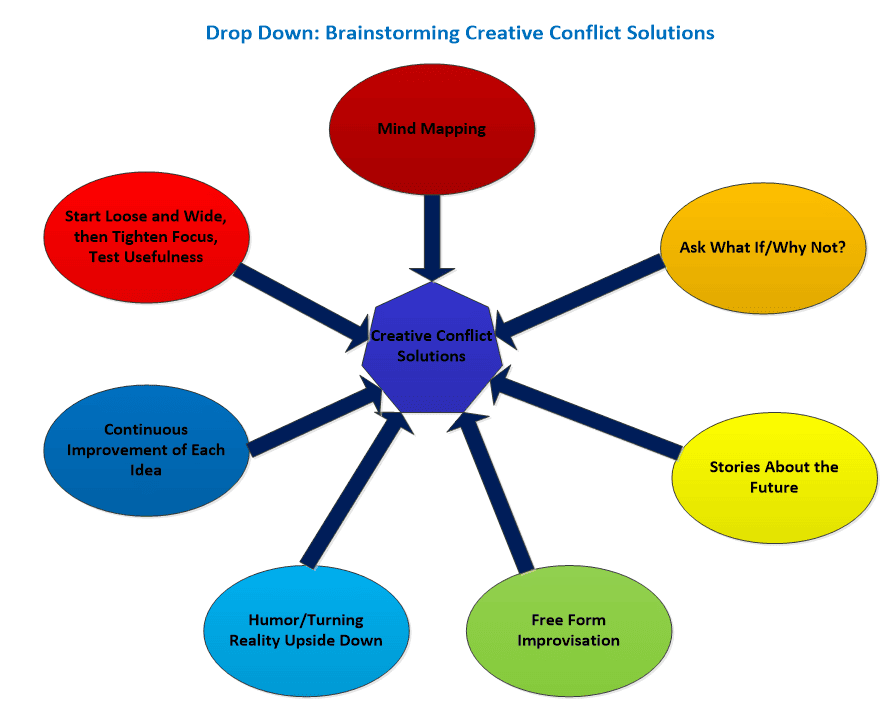
If the creative stage fails to produce any breakthrough thinking, in more difficult conflicts we may need to become stereoscopic and see the problem from both sides and use the creative tension of the differences in perspective to find some new breakthrough shift in perspective. We do this by:
- Assuming we are at an impasse, or that you feel there really is unrealized gain available in this conflict, either independently or jointly, try to take the most acute conflicts of interest, the greatest common interests, and the most significant different interests and hold all these contradictory perspectives in mind.
- Try to experience the conflict landscape stereoscopically.
- Let the tension of the paradox do its work.
- Brainstorm possible syntheses that would transcend these stereoscopic contrasts
- Take the respective paradigms or mental models or how the two sides see the conflict landscape. Look at them stereoscopically to see what insights it provides.
- Look at data white spaces (what you don’t know you don’t know) and see if filling in this data could shift the contradictions between our side’s and the other side’s perspectives.
- Is there a way of seeing the frontier of possible gains as a horizon: i.e., some way to go beyond, into new areas of mutual gain?
- Come at the situation from the viewpoint of constructing a radically different view of the future, add it to scenario based futuring, and see if that changes the perspective of both sides.
| Perspective of Side #A | Perspective of Side #B |
|---|---|
| Features of Side #A Perspective | Features of Side #B Perspective |
Having used maximum creativity to develop many additional new solutions or perspectives on the conflict, we are now going to try to converge on those “What Ifs” that show most promise as ways to resolve the conflict. We can look at the “What Ifs” to see which ones align best with the interests of both sides. We should also be mindful not to agree to anything that is worse than our Best Estimate of our Best Alternative to a Negotiated Agreement as that is the floor to any agreement, the definition of potential walk away point.
- Once the process of developing options via “what ifs” (and if needed, the process of “getting stereoscopic”) is complete, each side needs to compare the options generated with its own real interests and with its updated Best Estimate of the Best Alternative to Negotiation (BEBATNA) or what it can get unilaterally without agreement.
- Neither side would be wise to settle for less than its BEBATNA.
- Consider the “What if?” possibilities (independently of the other side) against our interests, listing them roughly as unacceptable, acceptable/can live with, preferred.
- Which possibilties are better than our BEBATNA? Check off those that are worse than our BEBATNA as unacceptable.
- We should rank order the best “what ifs” and check them against our interests and the other side’s interests.
- It may be helpful at an earlier stage to agree on the process of dividing up any gains made in the negotiation.
- In any event, it is essential that any deal that results from this process is clear, so there is no ambiguity as to what it means.
- If there are issues to be decided upon in the future, they should be clearly understood, and the process to be used agreed upon at this stage..
- In light of this, we should start to craft an agreement that captures the jointly preferred options and test it against both sets of real interests.
- We should continue to ask “Is this the best we can do?” and see if there are any improvements that make it better for one side or both without any reduction in another interest.
| 'What if' Option: | Side A in Conflict Reaction: | Side B in Conflict Reaction: |
|---|---|---|
The point of this stage is develop some lessons learned that can be applied to future conflicts, We should start any preparation for future conflicts by looking at these After Action Reviews which are not intended to blame or self-flagellate ourselves or anyone else. They are about admitting mistakes and learning to do better by:
- To learn from conflict, we have to reflect on what has happened systematically
- The US military use “after action reviews” to see what lessons can be learned from experience under the headings:
- What went well and why?
- What could have been better and why?
- What would we do differently next time?
- We might also reflect on what new skills we need to develop to handle conflict more effectively.
- Do we need to improve on the Creative Conflict Model to better meet our needs?
- Many organizations pretend to use this After Action Review process. But they fail to start the next round of action or new project with a review of the reluctant lessons from relevant past after action reviews. That defeats the whole point.
- So complete the after action reviews, store them where you can find them, and USE THEM to prepare for future conflicts!
| What ifs/ Interests | Interest #1 | Interest #2 | Interest #3 | Interest #4 | Interest #5 | Interest #6 | Interest #7 |
|---|---|---|---|---|---|---|---|
| What if #1 | |||||||
| What if #2 | |||||||
| What if #3 | |||||||
| What if #4 | |||||||
| What if #5 |